

Stagecoach Mary (Fields)
So. I was thinking about cowgirls. Whaaat?
Yep, cowgirls.
I was thinking about cowgirls and remembering a picture I found of my father as a young man. He was dressed, all six feet plus of him, in full cowboy regalia.He had on the fringe shirt, the pants, the boots, and a holster with two fake six guns at his hips. He had on a cowboy hat, and his hands were at his hips with both thumbs hooked onto the holster. Tough guy.
Cowboys. A symbol for me, at that age anyway, of tough goodness. Righteous goodness. The courage to take on the bad guys and make the world a better place.
That was a theme in our household. Make the world a better place. It came from the cowboy. As a child, I wanted—so badly—to take on the bad guys. And in our world of make-believe, we did just that.
My sister and I were among the few girls in our neighborhood who pretended to be cowgirls. If our brothers got cap guns, my sister and I got cap guns. If our brothers got cowboy hats…You betcha. My sister and I got cowboy hats.
Now, for sure, we were pretty feminine girls, schooled in many of the traditional tasks girls with southern roots were expected to learn. We embroidered. We crocheted. We made dresses with crinolines and large brimmed hats for the dolls that Mom sold to make extra money. We learned to cook — and I mean cook: perfect pies and cakes, succulent roast beef with biscuits and gravy. We put up vegetables and fruit in big Mason jars. There wasn’t a lack of things for good girls to learn.
But there was something exciting—creative—about things the boys got to do. Things like building model airplanes and navy aircraft carriers; things like putting together trains and train tracks. I loved that stuff. And for a moment— just a moment—I thought I would join the Armed Forces when I grew up. I can still feel the tiny pieces of gray plastic and the cellophane numbers for the ships beneath my fingers.
I can still smell the powder from the cap guns. Do they still sell cap guns, I wonder. Do children today know how to pretend? It seems like so many children who should be pretending are shooting for real these days. Where is the power of imagination and make-believe?
I wanted to be a cowgirl. A cowgirl had righteous business to take care of, and she took care of her business: Annie Oakley and Stagecoach Mary (one of the few historically documented black women of the old west). I’d bet my cowgirl holster and two cap guns that neither of those women ever picked up an embroidery hoop.
Today, I don’t own, nor do I want to own, a pistol—not even a cap gun.
I, my sister, and so many others still have a cowgirl’s heart. We want to make the world a better place. And while we may not actually be cowgirls, we are heroines in our ordinary lives, changing things daily and making the world a safer, kinder place. There is righteous business to take care of, and we can take care of business.
Yeah. A cowgirl’s heart.


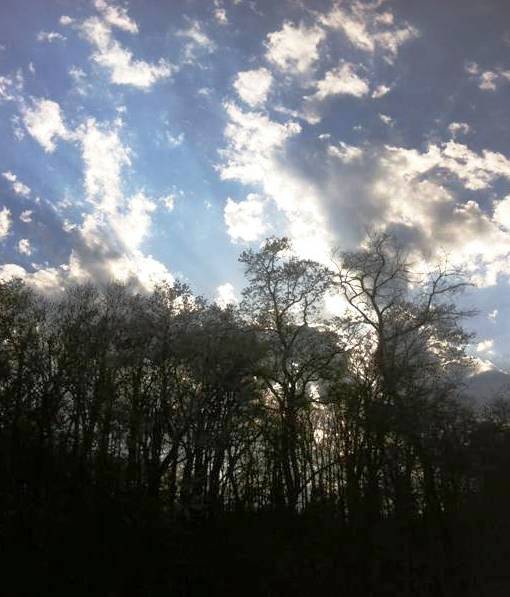
 Pastoral scenery. An all-black campus. These were my desires. I’d spent so much time in rural countryside that I deeply looked forward to the nature of things. I love this country landscape. But this is what I do not understand: with all of my love for the rural, how have I always resided so close to the city? More on that another time, but the fruit of my fertilization by both cultures cannot be underestimated.

 Sala
Sala

 wordshavecolor.com
On: Rethinking “Provincial”
If we’re lucky, we receive a kind of grace—a mercy or blessing you might say—that helps us let go of old, limited views, so that we can see how our biased loyalties harm ourselves as well as others. Today, I feel lucky.
I’ve ranted for years about insular communities spawning folk whose blind loyalties to narrow ideologies cause harm, exploit people, and breed hatred. I once wrote in these pages, “The provincial promises safety, but there is no reality in it.”
I’m not even sure what I meant by that, outside of understanding that I’ve vehemently disliked insular communities. Now, I’m changing my view. The fact that many parochial, narrow-minded communities are pariahs of the human race does not cancel out the fact that other small communities provide safety from exploitation and bigotry. The kind of thinking that led to the massacre of nine people in a South Carolina church this month is an example of the first; the openhearted warmth traditionally found in Southern black churches is an example of the second.
This morning, as I sip tea and watch hawks circle the air in search of something that died in the night, I’m reflecting on my limited understanding of provincialism. My perceived open-mindedness of urban sophistication is gone.
Three years ago I was diagnosed with Guillain Barre Syndrome, a condition that developed into chronic inflammatory demyelinating polyneuropathy, most commonly known as CIDP. I was unable to walk, hold anything in my hands, or go to the bathroom unassisted. My community became a closed world of doctors and medical practitioners, hospitals and rehab facilities, and friends as I learned that only one to eight in a million are diagnosed with CIDP. The insular nature of a serious illness can offer new perspectives.
A parochial mind can exist anywhere—in a family, among school friends, even in the heart of New York City—and, while I’m embarrassed to admit it, my own ideas about insular communities provided a false sense of security that, over time, became bricks in my wall of arrogance.
It’s been almost two years since my last serious relapse. I’m stable and a little wiser. I’ve had time for reflection. Not too long ago, I met a woman who is a talented needlework artist. She’d been working at the same job for 52 years, something I was never able to imagine for myself. In contrast to my life of weaving in and out of communities on this or that coast, she’d remained planted in the community where she grew up. She married well, and looking at her needlework it was clear that she was inspired by a broader outlook on the world. Yet, she was still connected to her community. She knew the people and their families, their histories, and I would not call her provincial.
Who are the provincial? Is it the uneducated hill woman in the mountains of West Virginia who saved me from bleeding all over the countryside? Is it the “sophisticated” urban professional who, as a supervisor, makes work life impossible for a subordinate? Are they the bluegrass and blues musicians hidden away in a back woods holler, welcoming everyone attending their gatherings with openhearted acceptance, or are they the religious zealots who insist at all costs that every person live as they live?
I can no longer paint the provincial with a single brush stroke. It’s become a heart-to-heart negotiation.
I think I’m finding an answer.
2 Comments
Posted in Commentary, Creative Non-Fiction, Essay, Values, Writing from the heart
Tagged Commentary, creative nonfiction, essay, narrow-minded, Opinions, provincialism, Reflections, values and spirituality, world view