
Hi there. I’ve been away for a while. It scares me because part of me is not clear how two months went by without writing a thing on these pages. Part of me wants to say that it has been my participation in other writing projects, but the other part of me knows better.
Prior to my diagnosis of GBS/CIDP, I was infatuated with my own cooking ability. Now that sounds egotistical, but the truth is: I would kiss myself in the kitchen. Now that I’m getting my strength back and can do some shopping, chopping, and sautéing (thanks to my food processor and Blendtec super machine), life is, I must say, very, very good. Take today, for instance. Do you smell that? It’s chicken livers and onions smothered in gravy. This former vegan is a happy eater.
There’s a lot of healing, and not just physical, that comes with preparing my own food. There’s no mystery to this. Folks have been writing about it for centuries and continue to write about it today. Food is healing, but cooking it yourself is quantum healing.
So about the title. I’ve never liked okra. By the way, that means never. Growing up with Southern food, okra was a major ingredient. There was stewed tomatoes and okra over rice dinner. And gumbo. There was also just plain old fried okra. If there is one vegetable guaranteed to get my gag reflex going, it’s okra. So imagine my surprise — really, I’m not kidding — when I was at the farmers market last week and I found myself reaching for okra. I’d heard that it has lots of anti-inflammatory qualities and vitamins and such, so I fell for it.
Before I go further, I want to point out that I figured out that my temporary separation from the blog was a good thing. I was swimming in the muck of what was wrong with this world. It doesn’t take much to hear it, see it, feel it. It’s all around us. Yet, once I started diving into writing about issues, something amazing happened. I stopped writing. I was depressed.
I know about issues. Look at me. I live in the United States. I know issues aplenty. But my reason for writing had fallen into a sewer of social and political angst. Preachiness, judgment, and— well, you know.
This morning, when I realized why I subconsciously took two months off, I took a photograph of my chicken livers. Damn, that felt good.

Back to okra. Two childhood foods stand out in my mind: my love for liver and onions and my distaste for okra. So, after I purchased the okra from the farmer, I needed to do something with it. I was moaning to an 80-year-old woman I know about my waste of money when she suggested that I fry them. I remembered frying okra at my mother’s suggestion 20 years ago. That was the last time I cooked okra.
Nevertheless, I gave it a whirl using a mixture of seasoned flour and Italian bread crumbs. Nothing fancy. Just the seasonings, the ghee that I fried them in, and the beautiful cucumber tomato salad on the side.
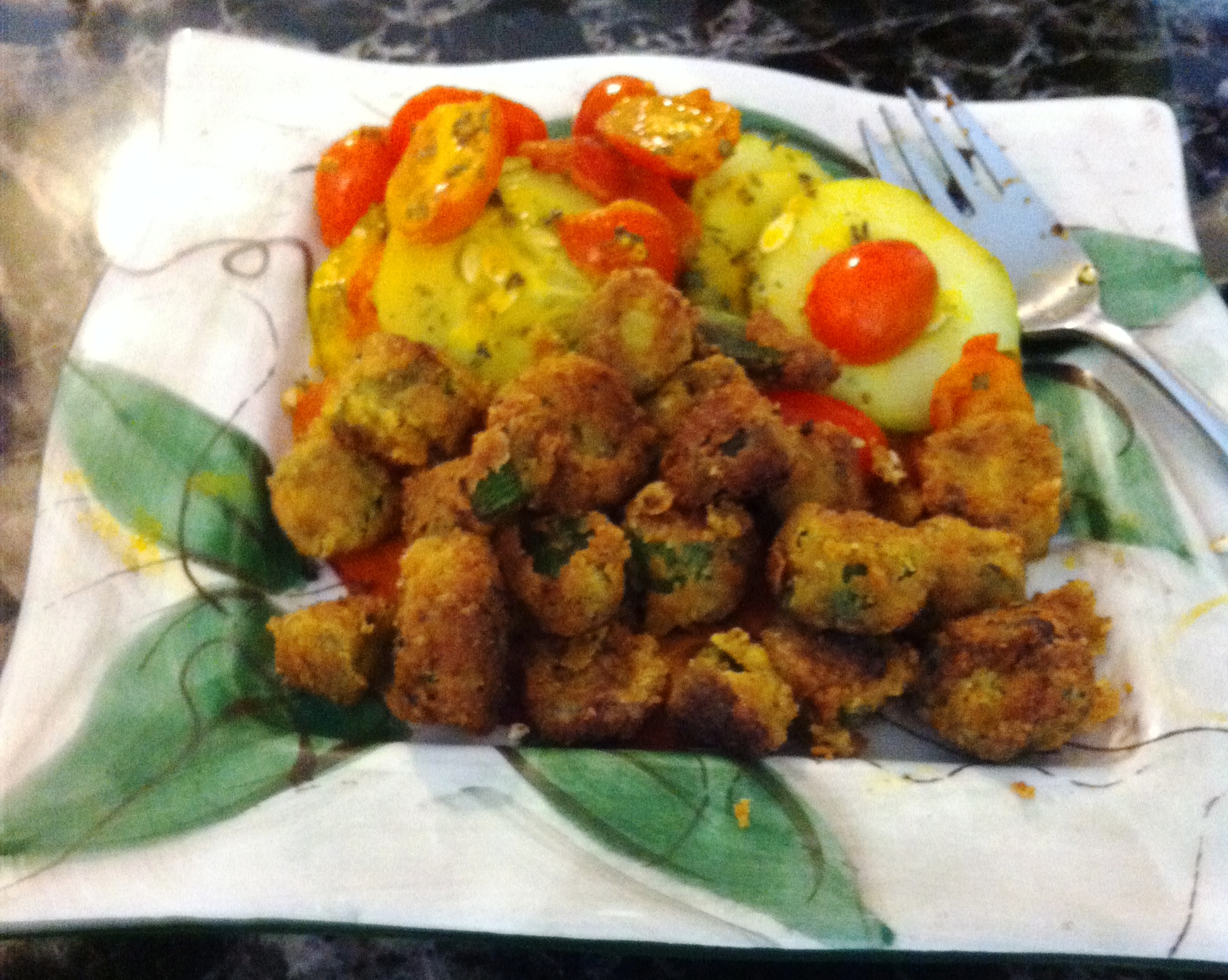
I’m no food stylist, and the pictures sure aren’t pretty, but I’ll tell you one thing: I’m out of my funk.
Welcome home, Sala.





 Sala


On: Rethinking “Provincial”
If we’re lucky, we receive a kind of grace—a mercy or blessing you might say—that helps us let go of old, limited views, so that we can see how our biased loyalties harm ourselves as well as others. Today, I feel lucky.
I’ve ranted for years about insular communities spawning folk whose blind loyalties to narrow ideologies cause harm, exploit people, and breed hatred. I once wrote in these pages, “The provincial promises safety, but there is no reality in it.”
I’m not even sure what I meant by that, outside of understanding that I’ve vehemently disliked insular communities. Now, I’m changing my view. The fact that many parochial, narrow-minded communities are pariahs of the human race does not cancel out the fact that other small communities provide safety from exploitation and bigotry. The kind of thinking that led to the massacre of nine people in a South Carolina church this month is an example of the first; the openhearted warmth traditionally found in Southern black churches is an example of the second.
This morning, as I sip tea and watch hawks circle the air in search of something that died in the night, I’m reflecting on my limited understanding of provincialism. My perceived open-mindedness of urban sophistication is gone.
Three years ago I was diagnosed with Guillain Barre Syndrome, a condition that developed into chronic inflammatory demyelinating polyneuropathy, most commonly known as CIDP. I was unable to walk, hold anything in my hands, or go to the bathroom unassisted. My community became a closed world of doctors and medical practitioners, hospitals and rehab facilities, and friends as I learned that only one to eight in a million are diagnosed with CIDP. The insular nature of a serious illness can offer new perspectives.
A parochial mind can exist anywhere—in a family, among school friends, even in the heart of New York City—and, while I’m embarrassed to admit it, my own ideas about insular communities provided a false sense of security that, over time, became bricks in my wall of arrogance.
It’s been almost two years since my last serious relapse. I’m stable and a little wiser. I’ve had time for reflection. Not too long ago, I met a woman who is a talented needlework artist. She’d been working at the same job for 52 years, something I was never able to imagine for myself. In contrast to my life of weaving in and out of communities on this or that coast, she’d remained planted in the community where she grew up. She married well, and looking at her needlework it was clear that she was inspired by a broader outlook on the world. Yet, she was still connected to her community. She knew the people and their families, their histories, and I would not call her provincial.
Who are the provincial? Is it the uneducated hill woman in the mountains of West Virginia who saved me from bleeding all over the countryside? Is it the “sophisticated” urban professional who, as a supervisor, makes work life impossible for a subordinate? Are they the bluegrass and blues musicians hidden away in a back woods holler, welcoming everyone attending their gatherings with openhearted acceptance, or are they the religious zealots who insist at all costs that every person live as they live?
I can no longer paint the provincial with a single brush stroke. It’s become a heart-to-heart negotiation.
I think I’m finding an answer.
2 Comments
Posted in Commentary, Creative Non-Fiction, Essay, Values, Writing from the heart
Tagged Commentary, creative nonfiction, essay, narrow-minded, Opinions, provincialism, Reflections, values and spirituality, world view